Towards a Sanctuary Church - an Ecclesiology of Christ

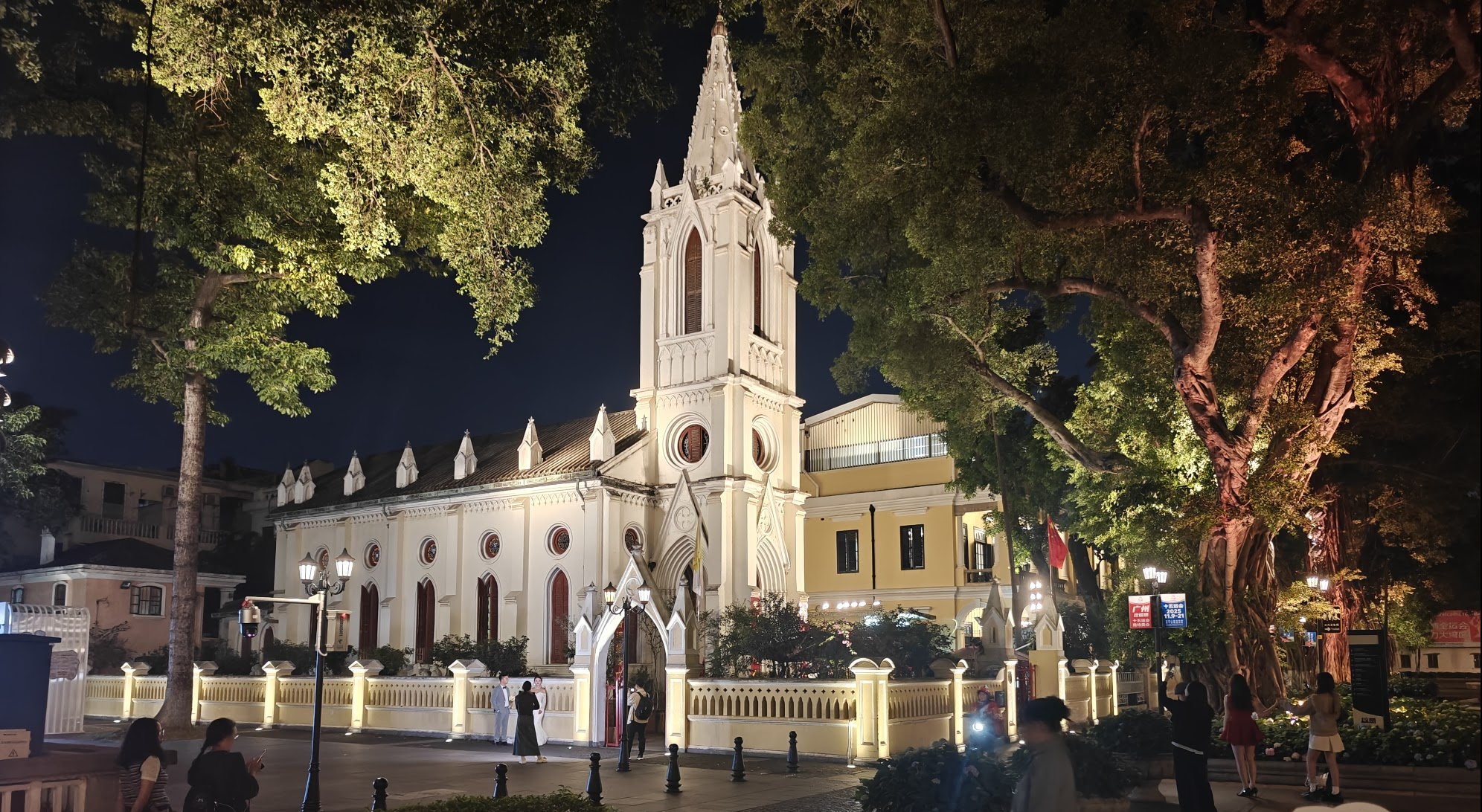
When I was summoned for an alleged battery, my compounded trauma response associates the police station with the torment endured by Xia (as referred in the earlier essay, The Human Acts, in which I fathom where God was). Naturally, during the break of the interrogation, I visited the Shameen (ex-)Anglican Church (currently the only provincial-administrated church) and sat on the end row of the pew to pray. As some helper watched me praying nervously, they kindly asked me if I wanted to see the parish pastor. Of course, I obliged.
What happened next was rather shocking. After hearing my case of a transgender person was subject to solitary confinement, bodily restraint, and political psychiatry, the parish pastor concluded that transgender people are voluntarily excluding themselves from the mainstream society and hence deserving no mercy when ‘death as a natural result for them’. I wasn’t very comfortable for the entire discourse, to put it mildly. But it prompted me into thinking if any part of that was our Christian teaching.
First, did Christ teach us that exclusion is of ‘deserving’? That one can be excluded care-free in our view, and death as the ‘natural consequence’ of that exclusion? Lord Atkin used the allegory in his famous judgment, that who is our neighbour – the man going from Jerusalem to Jericho, he was no neighbour than to the priest nor the Levite than the Samaritan. Naturally, the Samaritan was not obliged to him – he was not a neighbour in a communal or religious sense, but very much is as to a wounded man, precisely by his suffering. After all, we all lived in a very dark world where marginalised people and mainstream people don’t talk with each other. But not for the Samaritan here – he ‘bound up his wounds, pouring on oil and wine. Then he set him on his own animal and brought him to an inn and took care of him. And the next day he took out two denarii and gave them to the innkeeper, saying, “Take care of him, and whatever more you spend, I will repay you when I come back.”’
Not only he performed first-aid in a dangerous environment, but he also rescued him and gave the innkeeper two denarii – up to 24 days of modest food. (Bruce J. Malina and Richard L. Rohrbaugh, Social-Science Commentary on the Synoptic Gospels (Minneapolis, MN: Fortress Press, 2003), 351–352.) It was not someone who’s mainstream to put someone marginalised under the mercy, it’s the other way around. If love and grace can suspend the hatred of the marginalised, there is no reason the love of the mainstream can be isolated.
Therefore, it could not be argued that it is also a theological statement that the transgender people should be cast away, and worse, accepting death as a consequence of the marginalization. In Barmen Theological Declaration, and as I have repeatedly mentioned, it affirms that ‘Jesus Christ, as he is attested to us in Holy Scripture, is the one Word of God whom we have to hear, and whom we have to trust and obey in life and in death.’ No word of Christ condemned transgender people – or indeed any person – into an isolating death. But in many orthodox traditions, we proclaim, ‘Christ is risen from the dead, trampling down death by death’. Jesus never abandoned the dying humankind, but He redeemed sinners – without any merit of their part – through his own death as one rejected, humiliated, and condemned by this world.
Indeed, ‘We reject the false doctrine that there could be areas of our life in which we would not belong to Jesus Christ but to other lords, areas in which we would not need justification and sanctification through him.’ Whilst it’s being argued by many denominations that transgenderism is a ‘gender ideology’, no denomination, in their good conscience, has denounced the humanity of transgender people. No chapter, nor verse in the Bible denounces sinner – if they are indeed sinner – to an artificial death.
It begs a question, where is God when our kind are suffering? When God, calling His Father why has He forsaken Him, where is God? God is not in full glory, he is also in our suffering, in our torment and humiliation. Should we point towards God in high when our kinds are suffering? No, we should point God among us, for He is in our defeat, as he has been defeated, and risen with glory. If God is in our defeating and glory, where the Church – the Bride of Jesus – should be?
In Gaudium et Spes, the Council mentions that ‘in our times a special obligation binds us to make ourselves the neighbour of every person without exception and of actively helping him when he comes across our path, whether he be an old person abandoned by all, a foreign labourer unjustly looked down upon, a refugee, a child born of an unlawful union and wrongly suffering for a sin he did not commit, or a hungry person who disturbs our conscience by recalling the voice of the Lord, "As long as you did it for one of these the least of my brethren, you did it for me" (Matt. 25:40).’ Our conscience should be equally disturbed if a minority in their gender expression or sexual orientation being persecuted: by arbitrary detention, by torture, by degrading living condition, or by insulted human dignity; this should be a proclamation without any seed of doubt when we utter.
Wherever we make room for one another in Christ, we bear witness to the communion into which he has called us.
The Church should be a sanctuary, where the cries of a transgender child of God are heard and answered; the Church should be a witness to justice, where the persecuted are defended against injustice; the Church should be a communion in which even those most despised by the world are regarded with tenderness.
Let our hearts become sanctuaries, so that no one who comes among us shall be treated as a stranger.