Sermon on the Vigil of 4th June Massacre, 2026

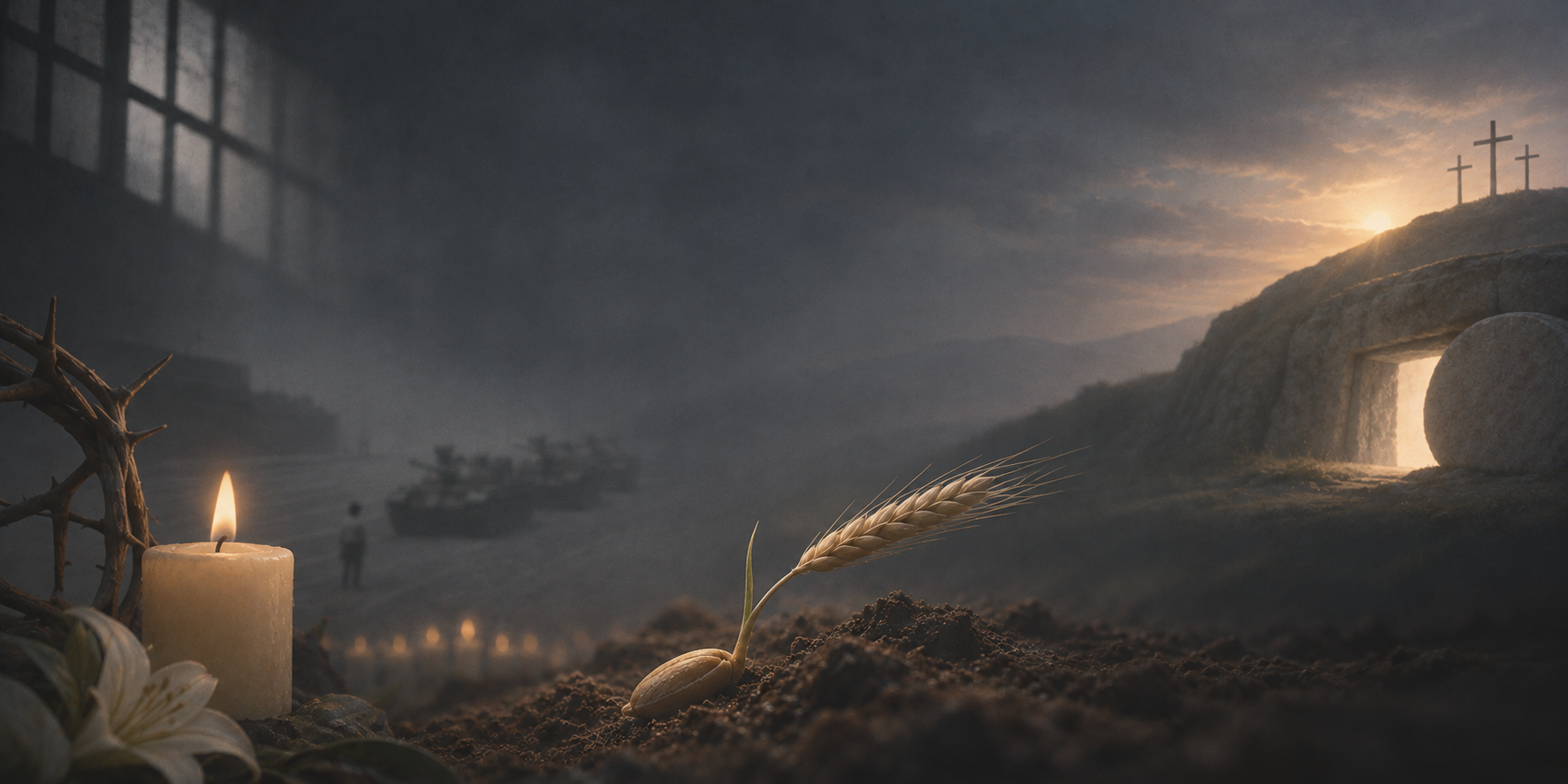
(Photo and translation are AI-assisted. It was delivered in Mandarin, drafted in Traditional Chinese.)
Dear brothers and sisters in Christ,
Every year, the Tiananmen Mothers issue a statement. As families of those who were killed, their demands have remained remarkably consistent for almost four decades: reveal the truth about June Fourth, provide just compensation, and hold those responsible for the massacre to account.
Thirty-seven years have passed. Yet the Tiananmen Mothers have still been denied the freedom to mourn their children. The candles in Victoria Park have long since been extinguished. Meanwhile, the Hong Kong government is prosecuting Ms Chow Hang-tung of the Hong Kong Alliance under laws of the most absurd kind, seeking to have her imprisoned.
What have thirty-seven years of unceasing appeals achieved? On the face of it, nothing at all.
Some friends have even asked me, "Why do we keep returning to the same event, almost forty years later?"
The most straightforward answer, of course, is that for almost forty years, we have not been allowed to speak of it. Yet the frustration behind that question is real, and it deserves to be taken seriously.
What, then, ought Christians to make of all this?
Perhaps among those gathered here today, there are more friends who have not yet entered the Church than those who are already within it. I believe, however, that our answer should be simple, whoever we may be:
Not one person should have died.
And in Christ, no human being is beyond the reach of God's mercy.
This means entrusting every person, living or dead, into the hands of God.
Concerning those who were killed by an army sworn to protect the very people it turned against, the Scriptures, even before the coming of our Lord Jesus Christ, proclaimed:
"The souls of the righteous are in the hand of God, and no torment shall touch them."
Even for those who committed the killings and have since died, the Church teaches us to pray, and to entrust their lives to God.
Through the prophet Ezekiel, the Lord declares:
"I take no pleasure in the death of the wicked, but rather that they turn from their ways and live."
Brothers and sisters, we do not pray for the regime they served. We do not pray in approval of what they did. We pray for their humanity and their conscience, just as we pray for the righteous who were killed.
We entrust them all into the hands of God.
I should now like to speak, to our friends both within and beyond the Church, about what Christians ought to do, and what all of us can do.
The first martyr in Christian history was Saint Stephen.
Stephen was a deacon whose ministry included the distribution of food. Yet one day, members of the local community brought accusations against him before the authorities, claiming that he had continually spoken against the holy place and the law.
Stephen bore a magnificent witness. Before them all, he spoke courageously of how the ancestors of Israel had persecuted the prophets.
I want to tell you how Scripture describes the suffering and death of Stephen. The passage is long, but I dare not leave it unread.
In the Acts of the Apostles, 7:54–8:1, we read:
"When they heard these things, they were furious and ground their teeth at Stephen.
"But Stephen, filled with the Holy Spirit, gazed into heaven and saw the glory of God, and Jesus standing at the right hand of God.
"And he said, 'Look! I see the heavens opened and the Son of Man standing at the right hand of God!'
"At this they cried out in a loud voice, covered their ears, and rushed upon him together. They dragged him out of the city and began to stone him. The witnesses laid their cloaks at the feet of a young man named Saul.
"While they were stoning Stephen, he called out, 'Lord Jesus, receive my spirit.'
"Then he fell to his knees and cried out in a loud voice, 'Lord, do not hold this sin against them.'
"And when he had said this, he fell asleep.
"And Saul approved of his death."
Brothers and sisters, with Saint Stephen, the Church received her first martyr.
The word martyr comes from the Greek μάρτυς (martys), meaning a witness.
Martyrdom is not the pursuit of death. Nor is it an excuse for recklessness.
Martyrdom is the act of bearing witness, even unto death.
And so, what Stephen saw in his final moments was not simply Jesus Christ seated at the right hand of the Father, as Scripture so often describes him.
He saw something more wonderful still.
He saw Jesus Christ standing.
Christ had risen from his seat, ready to receive him, to welcome him with open arms into a better place.
In the earthly court, they condemned Stephen to death by stoning. But in heaven there would be no more suffering.
Those who could find no shelter from the storms of this world would face no more storms in heaven.
Brothers and sisters, among our friends are many who have died for righteousness. Whether or not they themselves possessed such hope in their final moments, Jesus Christ rises from his throne and opens his arms to welcome them into the Kingdom of God.
As the Letter to the Hebrews tells us, we may approach the throne of grace with confidence, and receive the glory and dwelling place which the Lord has prepared for us.
And so, as we have heard in the Gospel, Stephen was more than a conqueror in all these things. He bore a magnificent witness.
"Unless a grain of wheat falls into the earth and dies, it remains only a single grain; but if it dies, it bears much fruit."
Before his death, Stephen prayed for those who persecuted him:
"Lord, do not hold this sin against them."
Among his persecutors was a young man named Saul, who, even after hearing this prayer, approved of Stephen's death.
Yet Saint Augustine tells us:
Si sanctus Stephanus sic non orasset, Ecclesia Paulum hodie non haberet.
"Had Saint Stephen not prayed as he did, the Church would not have Paul today."
Brothers and sisters, this very Saul, who approved of Stephen's killing, would become Paul, the Apostle to the Gentiles.
From the first grain of wheat that fell into the earth came one of the foremost apostles of the Church, honoured alongside Saint Peter himself.
Perhaps Stephen's martyrdom was the beginning of Paul's awakening. From that moment onwards, Paul devoted his life to running the race for truth and righteousness.
He wrote a substantial part of what would become the New Testament, in the letters we know as the Pauline Epistles.
And he continued until he, too, fell asleep for the sake of the faith he had kept.
Paul himself became another grain of wheat, from which the Church throughout the world would grow.
At the end of his life, he declared:
"There is laid up for me the crown of righteousness, which the Lord, the righteous judge, will give me on that Day; and not only to me, but also to all who have loved his appearing."
Dietrich Bonhoeffer, whose words we read earlier, was another man who longed for the appearing of Christ.
Brothers and sisters, I do not want you to be unaware of something.
Many among us who are unfamiliar with Christianity imagine that it preaches a gospel of cheap grace.
They believe that Christianity teaches us simply to pray, and God will provide: wealth, prosperity, and an exalted place in society.
Christianity does not deny that the Lord may bestow gifts upon those whom he chooses, and that these gifts may sometimes include wealth or worldly standing.
But we know what the highest calling is:
To bear witness to the Lord, even unto death.
This is what we call martyrdom.
Martyrdom does not mean seeking death. As you know perfectly well, deliberately seeking one's own death is something quite different.
Martyrdom means bearing faithful witness to the truth, whatever the cost, even when life itself becomes bitter, humiliating, or unbearable.
Bonhoeffer rejected cheap grace by reminding us of the cost of discipleship.
He wrote:
"When Christ calls a man, he bids him come and die."
Historically, Christianity has often encouraged obedience to those who exercise earthly authority. But that obedience has never been without limits.
In the twentieth century, the great Swiss theologian Karl Barth, in his celebrated Commentary on the Epistle to the Romans, opposed the notion of violent revolution. He did not believe that humanity could overcome violence through violence, or bring about truth and love by force.
Yet in Nazi Germany in 1934, when the state systematically distorted the Christian message and turned it into an instrument of racial ideology, Barth drafted the Theological Declaration of Barmen.
This declaration, whose principles Bonhoeffer would uphold with his very life, was an unequivocal rejection of Nazi propaganda.
Its first thesis proclaimed:
"Jesus Christ, as he is attested to us in Holy Scripture, is the one Word of God whom we have to hear, and whom we have to trust and obey in life and in death."
Just as no political propaganda or manipulation could alter the meaning of Scripture then — a message in which Jews and Gentiles stand alike before God — so no political propaganda can alter our responsibilities today.
No political propaganda can change our duty towards our neighbours, our sisters and our brothers.
No political propaganda can change our obligation to remember the dead, or our conviction that not one person should have died.
And no political propaganda can make us forget their names.
The names of transgender people who died because of abuse inflicted by society, by churches, and by their own parents.
Three years after the Barmen Declaration, Pope Pius XI issued the encyclical Mit brennender Sorge — With Burning Concern — which was secretly distributed among Catholic churches in Germany.
Bishop Clemens August von Galen of Münster publicly exposed the Nazi T4 programme: a campaign of killing people whom the regime considered to have lives "unworthy of living".
The Nazis came close to having him executed for his opposition.
All these people bore a magnificent witness for us.
Brothers and sisters, I have also encountered a name of extraordinary beauty:
Am Spiegelgrund.
It is the name of a place in Austria, a name which may be rendered in English as "At the Mirror Ground".
Yet behind this beautiful name lies an almost unimaginable evil.
During the Nazi era, a physician named Hans Asperger produced one of the early clinical descriptions of autism.
He also distinguished certain autistic children as more intelligent and more useful to society.
In the language of that regime, they were children whose lives possessed "value".
I myself am one of those who might once have been described as "Asperger's children".
Yet the person for whose sake I study law, and for whom I have fought, was judged by that society to have no value at all.
She was not one of Asperger's children.
And so Asperger marked a plus sign against her name on a form.
In the end, she died at the hands of this world, of this system, and of the society that sustained it.
She died at Am Spiegelgrund.
Knowing that I, too, am implicated in the sins of this society, I shall spend the rest of my life bearing witness to her.
Children whom society deemed to have "no value", Jewish children, children whose Nazi records bore two or three plus signs, were sent to Am Spiegelgrund.
There they were abused and killed.
At first glance, the things I have spoken about may seem entirely unrelated.
The Nazi genocide of the Jewish people.
The so-called euthanasia of vulnerable and disabled people.
The June Fourth massacre.
The abuse and discrimination suffered by sexual and gender minorities.
Yet these are precisely the places where we — every Christian, and indeed every human being — are called to bear witness.
For human dignity is not negotiable.
The dignity of a human being is not contingent upon any condition.
When I first began learning Latin, I encountered these words:
Gloria Dei, homo vivens.
"The glory of God is a human being fully alive."
This is what the Church has always proclaimed.
Whether someone is a perpetrator or a victim, cisgender or transgender, whether they lived in the twentieth century or the twenty-first, not one of them should have died.
Likewise, when we stand up for them, when we stand up for every single one of them, we do so because no one's humanity can ever be bought, sold, or bargained away.
Brothers and sisters, Bonhoeffer died.
He was executed only weeks before the end of the Second World War.
Martin Niemöller did not die. He survived.
These two leaders of the German Confessing Church, who lived out the principles of the Barmen Declaration, both bore faithful witness.
One bore witness through death.
The other bore witness through steadfast endurance.
Through their lives, they taught us that there are things which must be done, and things which must never be done.
There are commands which must be disobeyed, even at the cost of one's life.
And those who have paid dearly for their disobedience are not found only in Europe.
When Deng Xiaoping ordered troops to be deployed, as plans were made for the June Fourth massacre across China, Major General Xu Qinxian, commander of the People's Liberation Army's 38th Army, also received orders to mobilise his troops.
His army was, in effect, one of the formations entrusted with the defence of the capital.
He could have behaved like so many others in the upper ranks of the Chinese government.
He could have obeyed the orders to kill, and in return secured advancement, prestige, and honour.
But he did not.
At his secret trial, he said, in substance:
"To carry out an order of that kind with armed troops ... might make us sinners in the eyes of history. If such an order is to be carried out, it must first be approved by the National People's Congress."
He had risen to the rank of major general in the People's Liberation Army. Who knows how many things he might have done along the way that he ought not to have done?
Yet at that moment, he recognised something that he could not do.
A verbal order given outside the proper procedure offended the requirements of lawful command.
To turn armed soldiers against the people offended his conscience as a soldier.
He spent the remainder of his life under house arrest.
This major general, too, like Saul before him, was a man within the machinery of persecution who chose to heed his conscience.
He bore witness at the cost of the rest of his life.
He, too, became a grain of wheat.
Brothers and sisters, is the death of a grain of wheat in vain?
To the grain itself, it may certainly appear so.
It falls from the stalk, slowly loses its moisture, withers away, and disappears from the sunlight.
Yet, brothers and sisters, that grain of wheat has not merely fallen upon the earth.
It has returned to the earth.
Not one of us dies alone.
We die unto the Lord, and through the Lord we shall rise again.
There are many ways in which our lives may wither.
For some, it is martyrdom.
For others, it is the ordinary passage of old age.
And for still others, it is to spend the remainder of their lives in prisons, under house arrest, or subjected to torture.
The grain of wheat, too, passes through darkness.
It lies buried, unseen, as though imprisoned in the earth.
Richard Wurmbrand spent three years in solitary confinement, followed by five years among other prisoners, and was subsequently imprisoned a second time.
How did he resist?
Brothers and sisters, he hoped through faith.
And because he possessed hope, he bore witness.
We know that Jesus Christ died for our sins, and that in his resurrection we, too, are raised to new life.
From this knowledge springs our hope.
"The grass withers, the flower fades, but the word of our God will stand for ever."
With faith in the resurrection, our suffering is not in vain.
Our witness is sustained by hope.
In the Book of Lamentations, we read the words of the prophet Jeremiah:
"It is because of the Lord's mercies that we are not consumed, because his compassions never fail."
Under what circumstances did Jeremiah speak these words?
For decades, he had warned his own people.
He had been humiliated, beaten, and imprisoned.
And despite everything, he lived to witness the destruction of Jerusalem.
The city endured a siege lasting eighteen months.
Children died of hunger in their mothers' arms.
The suffering became so terrible that mothers cooked their own children for food.
Jeremiah had every reason to abandon hope.
Nor could he simply condemn God, for he understood that his own people's actions had brought them to this catastrophe.
And yet he protested.
His was a protest born of hope.
He declared:
"His compassions never fail."
His compassion did not fail.
When soldiers in Chengdu's Tianfu Square bound protesters' hands behind their backs, carried them to an overpass, and threw them down headfirst, the head of our Lord Jesus was broken with theirs.
His compassion did not fail.
When our sisters and brothers were imprisoned, or subjected to torture in institutions claiming to change who they were, the Lord suffered alongside them.
His compassion will never fail.
When we preserve the memory of these things as an act of witness;
When we are made outcasts because of that witness;
When we are persecuted for bearing that witness;
When we are imprisoned because we refuse to abandon that witness;
We know that our witness is not in vain.
For it is a witness borne in faith.
And that faith is the source of our hope.
Through this hope, we shall not be destroyed.
Every year, the Tiananmen Mothers mourn their children because they believe their children deserve to be remembered.
To be remembered for ever.
Chow Hang-tung continues to bear witness to the violence of that summer night. Even from prison, she continues her testimony.
Stephen, filled with the Holy Spirit, was granted a vision of truth, and prayed for those who were killing him.
Bonhoeffer hoped that something of Germany's Christian civilisation might survive the war. Holding fast to that hope, he walked to the gallows.
Xu Qinxian bore his witness, even though he spent the rest of his life in solitude and under surveillance, never living to see the political transformation for which others had hoped.
O Lord, at every moment, and especially at this moment, remain with us.
In a little while, we shall profess:
"We look for the resurrection of the dead, and the life of the world to come."
O Lord, we possess this faith because you came down from heaven for us and for our salvation.
Grant that throughout our lives we may bear witness with courage, steadfastness, and grace.
For we know that the God who calls us, even when he seems to answer us with silence, is still the God of yesterday, and the God of tomorrow.
Amen.