Intrinsically Disordered

Statement of AI Collaboration
This essay was written by human hands, born from lived experience and personal theological reflection. During the drafting and editing process, the author utilized Gemini 3.0 Pro as a collaborative editorial partner.
The AI's role was strictly limited to the functions of a developmental editor and cultural consultant. Specifically, it assisted with:
Tonal Consistency: Refining the specific "High British Noir" narrative voice and ensuring idiomatic accuracy for the dialect used.
Theological Stress-Testing: Verifying references to religious texts (including the CCC, Heidelberg Catechism, and the Book of Isaiah) and sharpening theological arguments.
Copyediting: Correcting grammar, syntax, and phrasing to polish the final draft.
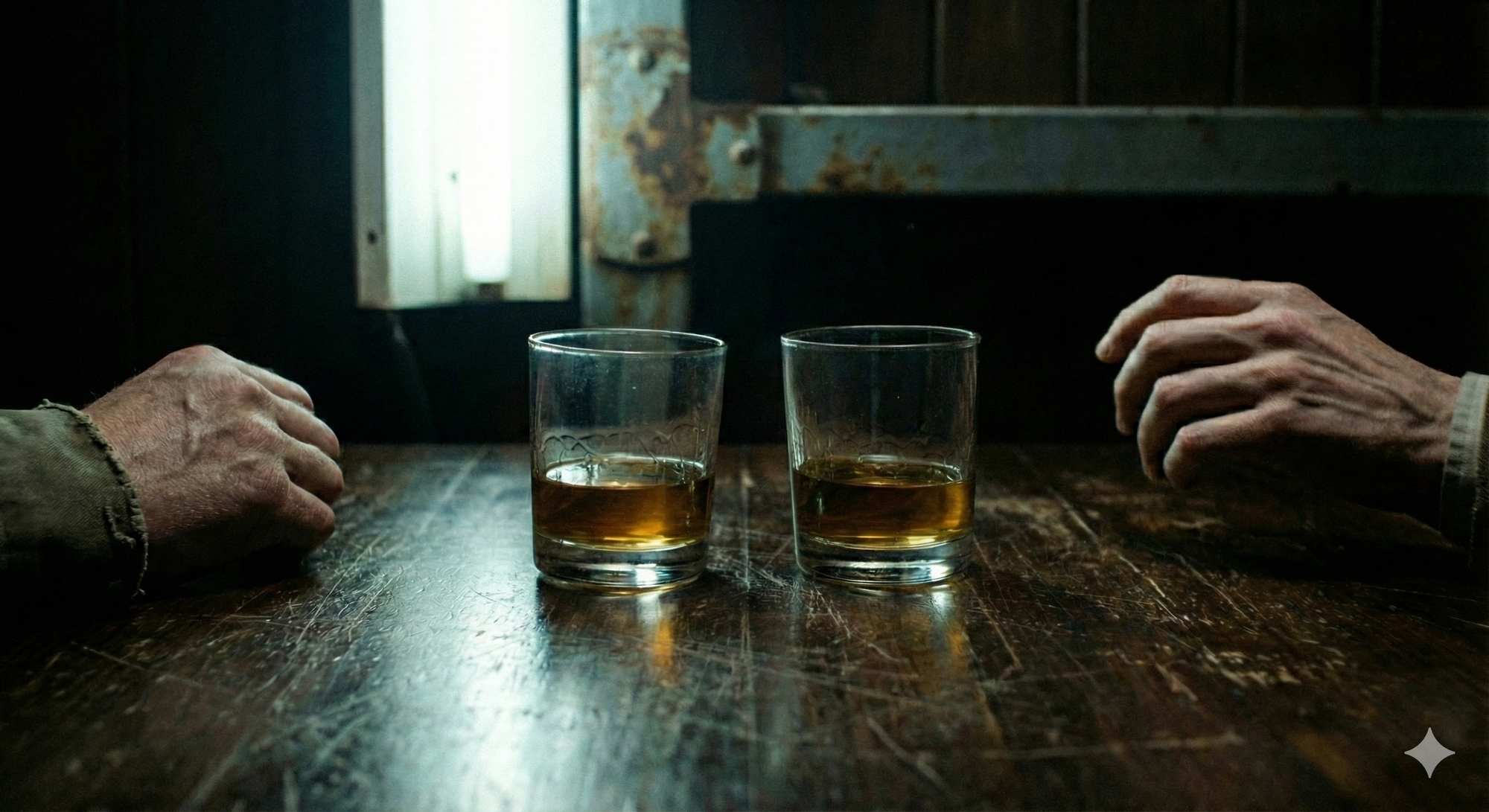
Banner Photo: The banner photo is generated by Nano Banana under the instruction of Gemini.
All narrative choices, core themes, personal disclosures, and final creative decisions remain the sole property and responsibility of the human author.
‘I’d rather go to hell if that means someone would be there to respond to me, you know. I’ve been seeking God in my life for very long, and there has been zero response. Well, then, after all, God hasn’t promised any response anyways, just an eventual ticket to heaven.’ He remarked, swirling his drink. He looked disappointed.
‘Well, but what if it means hell if you believe in Him?’ she asked, with the same distance.
‘What the fuck are you even talking about?’ He didn't bother to hide his disgust.
She took it in her stride, showing no surprise. ‘Would you survey all the sufferings on the Earth, all the effort, and all the love, for a God who is so detached and untouchable?’ She paused. ‘…and even devoting your current life and the next life just for Him, knowing that there will be no response and you yourself kept in the everlasting waiting in darkness?’
‘You must be mental. I stay away from that kind of talk.’ He pulled his glass closer to his chest, almost like a shield. ‘…but yes, I do know someone who holds the exact same idea as you. I wouldn’t mention her name, though. We had an agreement. We swore in the name of the Lord.’
Looking afar, she appeared to be speaking to herself. ‘She must be proper cringe, fucking hell.’ After all, her ex was a cringe person. But what’s wrong with being cringe? At least not to her, she reckoned.
‘I can’t tell you more about her. As I’ve said, we had an agreement.’
‘I don’t mind cringe people. I actually love them. After all, why does anyone stay sane and reserved in such a twisted milieu?’ She opened her arms, elaborating with full engagement. ‘Yes, I am asking a question—if we believe in God for the sake of St Augustine’s fear of the eternal barbecue in hell, wouldn’t that be a quid pro quo? If we test God to see if He rewards us, wouldn’t that be blasphemy?’
She continued, picking up speed. ‘So what did God promise about heaven? He said in Revelation that there will be forever praising of His glory. Seems less appealing, almost like attending a Broad Church without a break.’
‘But that would be the true faith, innit?’ She sighed, the passion draining out of her. ‘True faith which endures waiting, despair, anger, fear, disappointment. Someone who believes in faith itself, who finds warmth in loving.’
‘I wouldn’t do that. It’s simply sad and pathetic,’ he muttered, checking his watch. ‘And I would suggest you refrain from being so sad.’
‘Yes, exactly!’ she yelled.
He flinched.
‘A person of faith should be so petty, inferior, sad, and pathetic! We’ve had so many complacent High Church people, even SSPXs, those nastiest ones. They’d prefer grand churches, feeding on their disdain for Low Church folks. But now let us imagine an old lady crying when she hears the shabby hymns sung in any Protestant church. She prays to her God incessantly, she speaks about her God aloud everywhere she goes, even to the extent that the police took her to a psych ward.’
‘Our church despised her. That her missionary style wasn’t decent. That she always complained about our church letting part of our place to merchants. That she would tear off government posters. But she did it, she loves her God—she loves her God so dearly, takes the Passion so personally, weeping in such pain for her Lord. She praises her Lord even in the psych ward, so people in the ward start to believe in the Lord. Wouldn’t that beat “Your Reverence” and the decency and decorum of those fresh out of seminaries?’
‘Now you are being cringe,’ he said, looking tired. ‘I don’t find Sunday Christians bad. They are not living a consecrated life, but most people have to carry on with their lives anyway. You are sitting here sipping your Talisker, and that’s evidence of you living a regular life, no?’
He put his glass down, looking almost sympathetic.
‘You see, indeed. I make mistakes, and some people would find me disgusting—after all, I am a tranny. I have wants. I want a partner, a life where we can spend time together, a small garden if I could. I want to have the freedom to have roses together, with her.’ She lowered her head, lamenting a past she never had. ‘I never denied those wants.’
‘But I have a past. When I was a child, I read the CCC for leisure. I knew something was wrong with me. I thought I was gay. The Catechism has a summary explanation, and I can recite it word for word. “Tradition has always declared that homosexual acts are intrinsically disordered… under no circumstances can they be approved… they must be accepted with respect, compassion, and sensitivity… these persons are called to fulfil God’s will in their lives… and unite to the sacrifice of the Lord’s Cross the difficulties they may encounter from their condition.”’
‘Called to chastity, anyway. I was miserable as fuck. I thought multiple times of ending my own life, recalling the Heidelberg Catechism that “death is the end of sinning, and the entrance to the eternal life.” I thought about chemically castrating myself—hey, I actually achieved that later, didn’t I? Now, I do believe in the authority of the book, and every principle in it. But I choose not to believe in it.’
She took another sip, as if reminiscing about her old life of binge-drinking.
‘Ghastly. Mate, you should knock yourself out. Listen to yourself, you aren’t even making sense now. How can you believe in two contradictory things? Would you cut it out and talk about normal stuff? I would rather be listening to you complaining about Aberdeen being too cold.’ He raised his glass, pushing it towards her.
‘Yea. How? You must know Genesis. The binding of Isaac. Abraham took Isaac to the top of Mount Moriah. He wanted to kill Isaac. He meant to. If not, he cannot be the father of faith, but at best a very devoted person. And when he swung his knife… an angel stopped him.
‘What if the angel did not? Many interpretations say such a description was meant to stop human sacrifice. Now, I am not literate at all—after all, I did the Open University—but I believe Isaac would die. It’s expected! When a human is cut, they die.
‘God saved him. Very kind of Him. But what if God did not? What if Abraham loses the son entrusted to him by God? What if God disappears forever after Isaac’s death, leaving Abraham in permanent mourning, where Abraham would be accused as clinically crazy, and live in shame and isolation for the remainder of his life?
‘But I chopped Isaac’s head off, over and over again. I believed in God so fiercely, so as to follow His each and every order. I read systematic theology; I read Paul Tillich and Karl Barth. I read Calvin and, for God’s sake! I let the old bastard torture me for years. I would gladly enter a psych ward for life, or a prison.
‘But whilst Abraham one hundred and fifty per cent wanted to chop his head off, he believed in another thing. That God would keep his son, in this life, in the immediate world. Not as an abstract theological concept, not as some vague promise, but this body, in this world.’
‘Keep it down! It’s not a butcher’s shop,’ he hissed, glancing around the bar. He wanted this conversation to end.
‘He believed in a contradiction,’ she continued, ignoring him. ‘Ultimately, he believed in His providence and love, where he had no reason to do so.
‘But for me, I held the knife high really long. For five years. Until His revelation. That chopping did happen to me—in a sense I don’t believe it could have happened. Each second in those five years, I was chopping the neck of my dear Isaac. Each second, I chopped. Trust me, it was never easy—I chopped my dignity, my entire life, my love, my identity, but the cruellest part—I chopped on love itself.’
‘Bloody Christ! If you hallucinate that God is calling you to chop me up, will you do that?’ He was actually shaking his head now, looking for the exit.
‘Yes, I probably would. But at the same time, I would believe that God will hold you intact.’ She spoke as if he just asked her about the weather.
‘You are proper mental. You and your God can go fuck yourselves. For fuck’s sake, is there anything too much for you?’
She did not mind. She continued as if she were mumbling to herself. ‘Before I saw God, I also would. But just desperately.’
‘Seeing God?’
‘Yes. It was a late spring. I was writing a piece on the Tian’anmen Massacre. But the thing wasn’t in Beijing at all, it was in Chengdu.
‘Feeling surprised? Yea, you ignorant sods. There were massacres everywhere, not only in Beijing. Or to an extent, not only in Chengdu. People barely remember Beijing, let alone Tianfu Square. The American consul-general was there to tell the stories. Hotels being burnt; people were beaten shitless and hands tied behind their backs and thrown off the interchange, heads down. You can hear the sound of skulls being crushed, and they were tossed onto a truck. Even if there was any survivor, they would have suffocated to death! Those fucking commies.
‘But I was even angrier about God. Did they see Him before being thrown off the interchange? What purpose did their deaths serve, even? Where is the bloody old twat when the commies were murdering?
‘Then I saw Him. I shit you not, I just saw Him. He showed me streets I have been to. I was under immense financial pressure, yet He told me it’s alright—it’s alright to be broke. I am forced to appreciate His sense of humour. But He told me that I got Him. That He never leaves me. For fuck’s sake, you would think He would have given you some answers, like “I was there with them”, “I did my best to save them – ask the duty theologian,” or wiring a million Swiss Francs straight to my account. He did not give me an answer.’
‘Leaving your madness aside, what good does He do if no answer is given?’ He frowned, signaling for a fresh glass to cope with the disheartening conversation. ‘You know, help is available. Have you considered talking to a shrink? I mean, we all have our coping mechanisms. It’s fine. But chopping and visions…? You know, it’s alright to use some help.’
‘Yes, what good? I don’t know even today. Have you heard that verse, “I have heard you by the hearing of the ear, but mine eyes have seen you”? When Job said that he was entirely fucked up, just like me, to you. He was utterly sick, his family and property forfeited for nothing. He had been asking God for an answer, and he got none. He didn’t say that joyfully but was miserable as fuck. He knew no answer would avail, not in the face of such a God. Whatever pain or devotion, he had no control over himself, let alone God.
‘As for help… I don’t need any help. I know too well that my help isn’t in this world, not even from God, if you are thinking of a sane me. I wouldn’t benefit from a “secure environment”—you know, the term they use for those cages—if you are talking about that.’ She smirked.
He laughed, a dry, nervous sound. ‘I thought you must really believe in an almighty God, so why wouldn’t you be fixed by God?’
‘There was no need for fixing, really. I now understand why God did not save the citizens in Chengdu. God did not save them or even witness the killing.
‘God entered them. At that moment, they became Christ. Saving us, the survivors, from death. They became God. It’s Jesus’ skull that was broken. “Do this in remembrance of me.”’
‘Ghastly. Do you mean that God sacrificed them?’
‘No. Not in that sense. I still couldn’t quite figure how this system works, but I am quite certain that God remembers them—as humans. “A monument and a name.”’
‘Just like how I remember you.’ She tried to hide her light smile, whispering to herself.
‘That quote was from the Book of Isaiah. There was a quote for eunuchs, you know, people without testicles. “I will give you a monument and a name within my walls, that’s better than sons and daughters, which will never be cut off.” Things weren’t like this—before, anyone with a “crushed testicle” cannot enter the assembly of God. But it changes—foreshadowing the coming Son of Man, the one who would forgive us all, especially the most humiliated and marginalised. That night, God was with us, the victims and the soldiers alike.’
‘He did not respond to you. Actually, not much to me, either. But the silence is exactly His response. Because we are shreds of God—the image of God, the one who was crucified, beaten, and wept. Just as us, God was humiliated, spent time in isolation, experienced destitution—actually, He is experiencing us.’
‘Well, then. I guess He did not respond to me, either.’ The clinical white light of the rusty bar rendered his face even more tired.
‘Right. But still we are both sitting here, drinking to wash down our lives.’ She made an awkward smile.
He didn't know what else to say. He wasn't made for the dark.
He pushed his glass forward a few inches. A small, wooden scrape against the table.
She pushed her glass to meet his.
Clink.
The sound was dull.